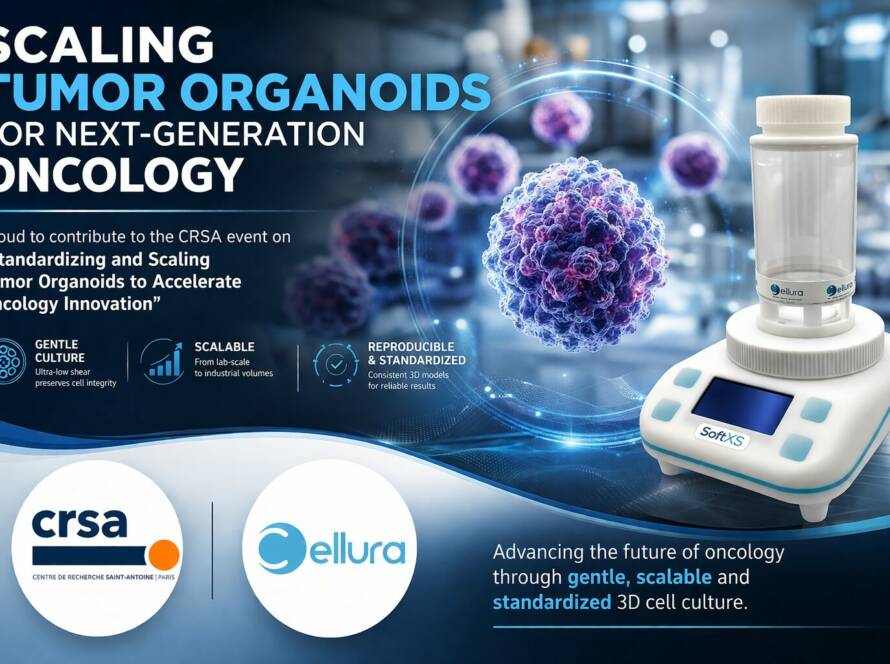
Cellura will participate in the upcoming PSCC Ecosystem Breakfast in Paris Saclay, where Benjamin Saulnier, CEO of Cellura, will present SoftXS™ as a breakthrough technology designed to address one of the most critical bottlenecks in oncology research: the standardization and scale-up of tumor organoids.
Tumor organoids have become essential tools for reproducing the biological complexity of human tumors. They enable more accurate modeling of heterogeneity, cellular interactions and therapeutic responses. However, their transition from research models to translational and industrial platforms remains limited by technological constraints.
The core issue is not biological potential. It is mechanical control.
The Hidden Limitation of Conventional 3D Culture
Traditional 3D culture systems rely on impellers or bubbling-based agitation. As volume increases, mechanical stress rises significantly. This generates:
• Elevated shear stress
• Heterogeneous oxygen and nutrient gradients
• Variability between batches
• Reduced reproducibility
For fragile systems such as tumor organoids, these mechanical constraints can alter viability, morphology and functional readouts. This limits their reliability in therapeutic screening and slows industrial deployment.
SoftXS™: A Shear-Controlled Innovation
During the PSCC session, Benjamin Saulnier will present SoftXS™, Cellura’s low-shear 3D bioreactor platform.
SoftXS™ introduces a bladeless, geo-inspired mixing system that creates controlled chaotic flow without impellers. Instead of increasing shear with scale, the system maintains:
• Homogeneous suspension
• Controlled mechanical forces
• Reduced shear stress
• Stable hydrodynamic conditions
Recent suspension studies demonstrate that homogeneous resuspension can be achieved at rotational speeds between 30 and 60 rpm, with shear levels 12 to 50 times lower than conventional bioreactors.
This is not a marginal improvement. It is a structural change in how 3D cultures are handled.
From Laboratory Model to Scalable Platform
The presentation will focus on key parameters that enable true standardization:
• Aspect ratio optimization
• Controlled tilt angle
• Critical suspension speed
• Hydrodynamic resonance conditions
• Scale-up without redesign
Unlike conventional stirred systems where scaling requires process reengineering, SoftXS™ maintains consistent operating principles from laboratory scale to industrially representative volumes.
This enables tumor organoids to move beyond experimental feasibility toward reproducible and scalable production.
Validated Scientific Foundations
The technological approach presented by Cellura is supported by scientific validation conducted by recognized experts in hematology and cellular therapy, notably the teams led by Annelise Bennaceur and Ali Turhan.
These validations confirm compatibility with fragile cellular systems including iPSCs, immune cells and organoids.
A Strategic Objective for Oncology
The objective of this PSCC session is clear:
Through shear-controlled technology, SoftXS™ transforms tumor organoids into a standardized, robust and industrializable platform capable of accelerating therapeutic screening, personalized medicine and oncology development.
By participating in the PSCC Ecosystem Breakfast, Cellura aims to contribute to the strategic evolution of organoid technology within the Paris Saclay oncology ecosystem.
SoftXS™ is not only a bioreactor. It is a new mechanical framework designed to unlock the full translational potential of complex 3D tumor models.
About the event
You may find more information about the PSCC Ecosystem Breakfast on the official event page: https://www.parissaclaycancercluster.org/news-du-pscc/categories/replay-petit-dej