The 29th ESACT Meeting brought together the international community of scientists, engineers, bioprocess specialists, technology developers, and industrial leaders working at the forefront of animal cell technology and advanced biomanufacturing. Held in Salzburg, Austria, ESACT remains one of the most influential scientific forums dedicated to cell culture technologies, bioprocess development, cell therapies, gene therapies, and next-generation biomanufacturing.
For Cellura, participating in ESACT 2026 represented an important opportunity to engage with the global ecosystem shaping the future of cell production and to contribute to ongoing discussions around one of the industry’s most critical challenges: how to manufacture fragile cells efficiently while preserving their biological integrity.
A Field Entering a New Manufacturing Era
Over the past decade, the biomanufacturing landscape has evolved considerably.
The rapid emergence of cell therapies, gene-modified immune cells, iPSC-derived products, organoids, and increasingly sophisticated biological models has transformed the requirements placed on cell culture technologies. While remarkable progress has been achieved in cellular engineering and therapeutic development, manufacturing remains one of the major bottlenecks limiting broader industrial deployment.
Producing fragile cells at scale requires more than increasing culture volume. It requires maintaining viability, phenotype, potency, and reproducibility throughout the entire production process. These challenges become increasingly complex as conventional systems generate higher levels of mechanical stress during scale-up.
Many of the scientific discussions presented during ESACT 2026 reflected this transition toward more robust, scalable, and predictive manufacturing strategies capable of supporting future therapeutic applications. Topics included digital bioprocessing, advanced cell manufacturing, computational modeling, process optimization, cell therapy production, and next-generation bioprocess technologies.
Why Gentle Cell Culture Matters
As cell-based products become more complex, the impact of physical culture conditions is receiving increasing attention.
Mechanical forces generated during culture can directly influence cell behavior, viability, differentiation potential, and overall product quality. This is particularly relevant for highly sensitive biological systems such as:
- Induced pluripotent stem cells (iPSCs)
- Immune cells
- Organoids
- Cell aggregates
- Microcarrier-based cultures
- Advanced regenerative medicine products
Reducing unnecessary stress while maintaining homogeneous culture conditions is becoming a central objective for modern bioprocess engineering.
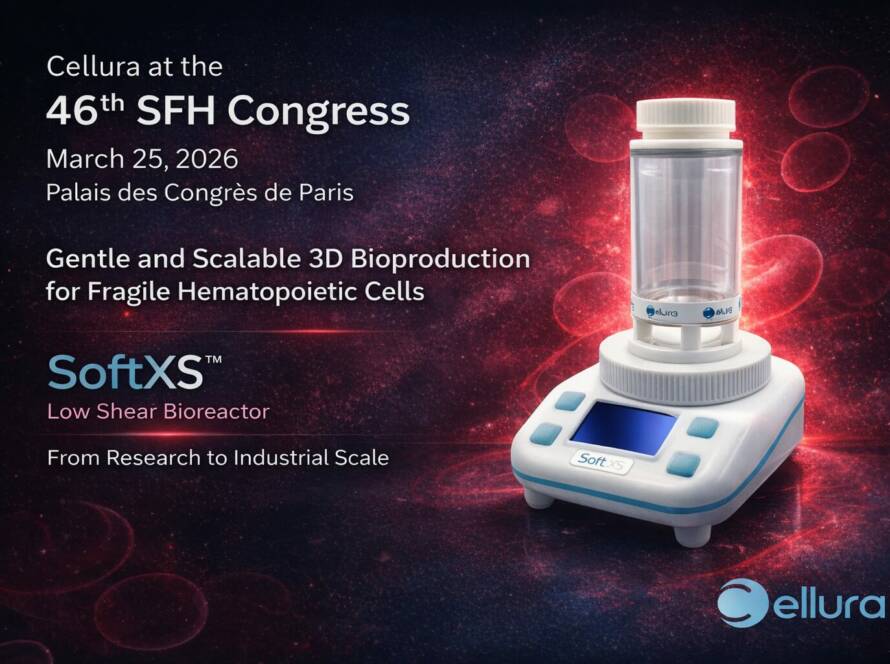
This challenge aligns closely with Cellura’s vision of enabling scalable cell production through low-shear culture environments specifically designed for fragile cells. Cellura’s SoftXS™ platform was developed to address these limitations through a patented bladeless mixing approach generating chaotic but highly controlled fluid dynamics, allowing efficient suspension while minimizing damaging shear forces.
Connecting Fluid Mechanics and Cell Biology
One of the most exciting aspects of ESACT is its ability to bring together disciplines that have traditionally evolved separately.
Cell manufacturing today sits at the intersection of:
- Cell biology
- Bioengineering
- Process development
- Computational modeling
- Automation
- Industrial production
Advances in therapeutic development increasingly depend on advances in bioprocess design.
Likewise, improvements in manufacturing performance often originate from a better understanding of how physical forces influence cellular responses.
At Cellura, this interdisciplinary approach is deeply embedded within the technology itself. The SoftXS™ platform originated from more than a decade of research combining fluid mechanics, engineering, and cell culture science to create a mixing environment inspired by natural rotational flows. This approach enables homogeneous suspension while maintaining exceptionally low shear conditions for sensitive biological systems.
Building Scalable Solutions for Emerging Cell Therapies
The future success of advanced therapies will depend not only on biological innovation but also on manufacturing innovation.
As cell therapies move from research laboratories toward larger-scale clinical and commercial deployment, the industry requires production technologies capable of supporting:
- Higher cell yields
- Improved reproducibility
- Reduced process complexity
- Simplified scale-up strategies
- Greater manufacturing consistency
- Lower production costs
Cellura’s development efforts are focused on addressing these requirements while maintaining the biological quality of fragile cell populations.
Current proof-of-concept studies have demonstrated successful applications across multiple sensitive cell types, including pluripotent stem cells, immune cells, organoids, microcarrier-based cultures, and highly shear-sensitive microalgae.
These results reinforce a broader industry trend discussed throughout ESACT 2026: future manufacturing platforms must combine scalability with biological preservation rather than forcing a compromise between the two.
Strengthening Collaboration Across the Cell Technology Ecosystem
Beyond scientific presentations, ESACT continues to play a vital role in fostering collaboration between academia, biotechnology companies, equipment manufacturers, CDMOs, and pharmaceutical organizations.
The exchange of ideas across these communities is essential for accelerating innovation and translating scientific discoveries into real-world therapeutic solutions.
For Cellura, ESACT 2026 provided valuable opportunities to engage with researchers and industrial stakeholders working across cell therapy, regenerative medicine, bioprocess engineering, advanced manufacturing, and next-generation biological production systems.
These interactions reinforce our commitment to developing technologies that help bridge the gap between laboratory-scale innovation and industrial-scale cell production.
Looking Ahead
The discussions and innovations showcased throughout ESACT 2026 highlighted the remarkable momentum currently driving the field of animal cell technology. As the industry continues moving toward increasingly complex biological products, scalable and cell-friendly manufacturing solutions will become a fundamental requirement rather than an advantage.
Cellura remains committed to supporting this transition through technologies designed to enable gentle, reproducible, and scalable production of fragile cells.
We would like to thank the ESACT community, organizers, scientific contributors, and industry partners for another outstanding edition of this landmark event.
We look forward to continuing these discussions and contributing to the future of advanced cell manufacturing.
About the event
More information about ESACT Congress is available on the official website: https://esact2026.com/
For further information or to arrange a meeting:
Email: contact@cellura.io