Adherent cell expansion has long relied on static two-dimensional culture systems, where cells grow as monolayers on rigid plastic substrates. While these platforms are simple and well established, they impose physical constraints that increasingly conflict with the biological and manufacturing demands of modern cell-based research.
However, as highlighted in Current Advances in 3D Dynamic Cell Culture Systems (Huang et al., 2022), the continued reliance on flat, static environments increasingly conflicts with modern biological and bioprocessing requirements. Emerging applications in cell therapy, regenerative medicine, and complex biological modeling now require culture systems capable of supporting higher cell densities, preserving functional phenotypes, and enabling scalable manufacturing. Within this context, traditional 2D culture has reached intrinsic physical and biological limits.
Dynamic three-dimensional culture systems represent a fundamental shift. Rather than constraining cells to artificial planar environments, these systems introduce movement, mechanical stimulation, and volumetric growth spaces that better reflect physiological conditions. This transition is not merely a technical upgrade, but a redefinition of how adherent cell expansion is designed and controlled.
Structural and biological limitations of flat 2D culture
Static 2D environments impose a highly artificial geometry on adherent cells. Cells flatten against rigid substrates, develop exaggerated spreading, and reorganize their cytoskeleton in ways that differ markedly from in vivo conditions. As emphasized in the reviewed source, this forced geometry directly impacts several interconnected biological parameters:
- intracellular tension and cytoskeletal prestress
- focal adhesion size, distribution, and stability
- activation of downstream signaling pathways linked to proliferation and differentiation
In native tissues, adherent cells exist within three-dimensional extracellular matrices and are continuously exposed to dynamic mechanical forces. They receive signals from neighboring cells, experience spatial constraints, and respond to fluctuating biochemical and mechanical cues. Static 2D culture removes much of this complexity, resulting in simplified cellular behavior that can be misleading when extrapolated to physiological systems.
Beyond biological distortion, flat culture systems rely primarily on diffusion for nutrient and oxygen transport. As cell density increases, gradients inevitably emerge, generating heterogeneous microenvironments even within a single culture vessel. These gradients contribute to variability in growth, metabolism, and viability, undermining both experimental reproducibility and scalability.
The scalability bottleneck of adherent monolayers
One of the most significant limitations of static adherent culture is scalability. Because cell growth is restricted to planar surfaces, increasing production requires proportional increases in surface area. In practice, this translates into:
- multiplication of flasks and multilayer vessels
- increased manual handling and labor intensity
- larger incubator footprint and infrastructure costs
As discussed in the reviewed article, such approaches rapidly become impractical for translational and industrial contexts. Manual interventions increase contamination risk, while maintaining consistent process control becomes increasingly challenging. For applications such as large-scale cell expansion or manufacturing workflows, static 2D systems represent a structural bottleneck, not a viable long-term solution.
Dynamic culture systems address this limitation by enabling volumetric expansion, effectively decoupling cell yield from planar surface constraints.
Redefining adhesion in dynamic environments
Dynamic 3D culture systems fundamentally alter how adherent cells interact with their growth substrates. Instead of attaching to immobile flat surfaces, cells encounter environments where substrates are exposed to continuous motion or fluid flow. This shift reshapes adhesion dynamics, cytoskeletal tension, and cell–cell interactions.
According to Huang et al., cells in dynamic systems experience transient rather than permanent attachment states, closer to those observed in physiological tissues. This dynamic balance between attachment stability and mechanical stimulation influences:
- proliferation kinetics
- cell morphology and spreading behavior
- functional state and responsiveness
Rather than forming uniform monolayers, cells adapt continuously to their mechanical context, opening new possibilities for controlled adherent cell expansion.
Mechanical stimulation as a biological signal
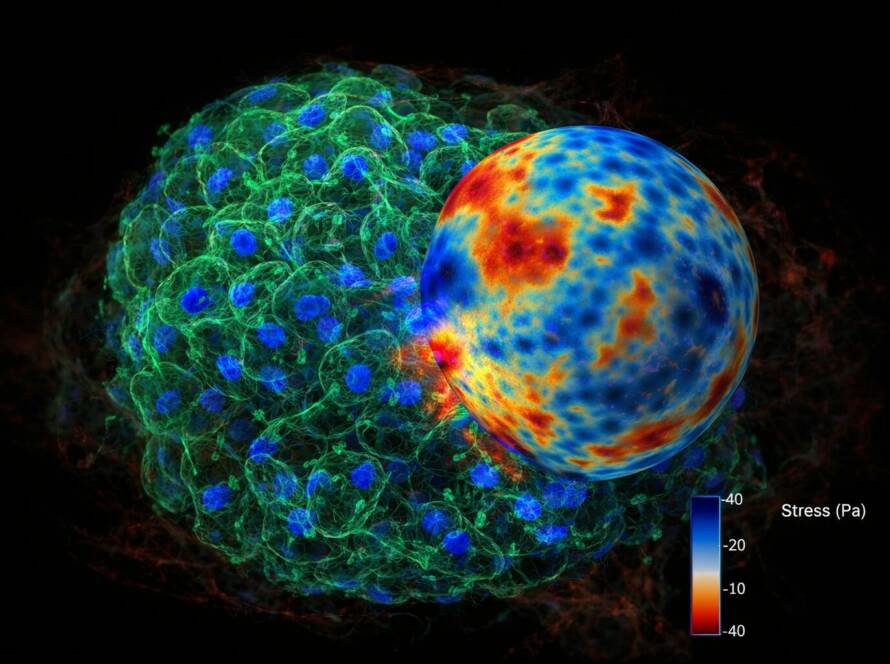
A central insight of the reviewed source is that mechanical cues actively regulate cell behavior. In dynamic culture systems, forces such as fluid-induced shear stress or cyclic mechanical exposure are not incidental by-products of system operation. They act as biological signals that modulate intracellular pathways.
Mechanical inputs influence:
- integrin-mediated adhesion signaling
- cytoskeletal organization and force transmission
- mechanotransduction pathways controlling gene expression and proliferation
When carefully controlled, mechanical stimulation improves nutrient transport, limits waste accumulation, and supports more homogeneous cell populations. When poorly controlled, excessive mechanical stress can induce cell damage, detachment, or phenotypic drift. Successful dynamic culture therefore depends on engineering environments that deliver mechanical inputs within biologically permissive ranges.
Dynamic systems and volumetric cell expansion
By enabling adherent cells to expand within three-dimensional volumes rather than across two-dimensional planes, dynamic culture platforms support significantly higher cell densities in compact systems. The reviewed article highlights that improved mass transfer and reduced microenvironmental heterogeneity allow sustained proliferation at scales that are difficult to achieve in flat culture.
Importantly, volumetric expansion alone is insufficient. Biological performance must remain consistent as systems scale. Dynamic platforms must therefore ensure:
- uniform mechanical exposure across the culture volume
- reproducible attachment conditions
- stable nutrient and oxygen delivery
to achieve predictable and reproducible outcomes.
Integrating biology and process engineering
Adherent cell expansion in dynamic systems sits at the interface between cell biology and bioprocess engineering. Traditional approaches often aim to minimize mechanical disturbance, treating physical forces as variables to suppress. Dynamic systems invert this logic by integrating mechanical cues as deliberate design parameters.
As highlighted in the reviewed source, successful dynamic culture aligns biological requirements for adhesion and signaling with physical parameters such as flow profiles, mixing regimes, and surface presentation. This integration challenges assumptions inherited from static 2D culture and encourages the development of systems in which biological behavior emerges from coordinated biochemical and mechanical control.
Toward a new paradigm for adherent cell culture
Breaking the flat culture paradigm opens new possibilities for adherent cell expansion. Dynamic 3D systems offer pathways toward higher yields, improved reproducibility, and enhanced physiological relevance. Rather than forcing cells to adapt to rigid and artificial substrates, this approach adapts the culture environment to cellular biology.
This shift defines a new framework for adherent cell culture that aligns with the evolving demands of research, translational science, and biomanufacturing.
Scientific background: Current advances in 3D dynamic cell culture systems, Gels, 2022.