La suspension reste un défi majeur dans les cultures cellulaires modernes
Le maintien d’une suspension homogène tout en préservant un environnement hydrodynamique doux demeure l’un des principaux défis des systèmes de culture cellulaire en suspension.
De nombreuses structures biologiques utilisées dans la recherche et la bioproduction, notamment les cellules souches, les organoïdes, les cellules immunitaires, les agrégats cellulaires et les cultures sur microporteurs, sont sensibles aux contraintes mécaniques.
Les bioréacteurs conventionnels à cuve agitée reposent généralement sur des turbines internes pour générer le mélange, produisant des turbulences localisées, des gradients de cisaillement, des zones de sédimentation et des environnements fluides hétérogènes.
La plateforme SoftXS™ a été développée pour surmonter ces défis grâce à un système de rotation inclinée sans turbine capable de générer une suspension continue dans des conditions de faible cisaillement.
Un principe de mélange différent
Contrairement aux systèmes agités conventionnels, SoftXS™ fonctionne sans turbines internes.
La combinaison de :
- La vitesse de rotation
- L’angle d’inclinaison
- La dynamique de la surface libre
- La géométrie du récipient
génère une advection chaotique et une resuspension continue des particules dans l’ensemble du volume de culture.
Cette conception permet :
- Une suspension homogène
- Un mélange continu
- Une réduction des contraintes hydrodynamiques
- L’absence de cisaillement induit par une turbine
- L’absence de turbulences localisées
créant un environnement plus homogène et mécaniquement plus doux pour les systèmes biologiques sensibles.
Démonstration d’une suspension prévisible à différentes échelles
Afin d’évaluer les performances de suspension, des microbilles fluorescentes de polyéthylène présentant une densité similaire à celle des agrégats biologiques ont été utilisées comme particules modèles.
Trois populations de particules ont été étudiées :
- ~100 µm
- ~400 µm
- ~1300 µm
Les expériences ont été réalisées avec des volumes de récipient de 10 mL, 50 mL et 250 mL, dans des conditions hydrodynamiques identiques.
Les résultats ont démontré :
- Une suspension homogène maintenue de 10 mL à 250 mL
- Un comportement de changement d’échelle prévisible
- Une suspension stable sans turbines internes
- Des performances hydrodynamiques constantes sur tous les formats de récipients
Les particules de plus grande taille nécessitaient des vitesses de rotation plus élevées pour surmonter la sédimentation, tandis que les récipients de plus petit volume nécessitaient des vitesses plus élevées afin de maintenir des conditions de suspension équivalentes.
Il est important de noter qu’un rapport H/D de 0,7 minimisait la vitesse critique de suspension (Nc) nécessaire pour obtenir une suspension stable.
Définition des plages de fonctionnement pour une suspension homogène
L’étude a identifié trois régimes de fonctionnement distincts.
Régime homogène
- Suspension complète des particules
- Aucune sédimentation visible
- Mélange stable sur toute la hauteur
Régime limite
- Sédimentation partielle
- Efficacité de suspension réduite
- Comportement de suspension transitoire
Régime non homogène
- Accumulation importante de particules
- Forte hétérogénéité spatiale
- Suspension incomplète
Ces résultats démontrent que les performances de suspension sont principalement contrôlées par la taille des particules, la vitesse de rotation et la géométrie du récipient.
Validation quantitative à l’aide de l’imagerie laser
Afin de valider indépendamment l’homogénéité de la suspension, l’étude a combiné l’imagerie par feuille laser, l’analyse du coefficient de variation (CV) et le comptage des particules.
Les conditions de fonctionnement homogènes ont systématiquement présenté :
- De faibles valeurs de CV (<15 %)
- Une sédimentation négligeable
- Une distribution uniforme des particules dans toute la colonne liquide
L’analyse a également démontré que le CV seul est insuffisant pour caractériser pleinement la qualité de la suspension, car certaines conditions présentant une sédimentation partielle peuvent malgré tout afficher des valeurs de CV relativement faibles.
La combinaison de l’analyse du CV avec le comptage des particules fournit donc un cadre plus robuste pour définir la véritable homogénéité de la suspension.
Mélange dynamique et suivi des particules
Les expériences de suivi de particules individuelles ont confirmé la nature dynamique du mécanisme de suspension de SoftXS™.
Les particules suivies ont exploré en continu le volume accessible du bioréacteur sans rester confinées de manière prolongée dans des régions localisées.
Ce comportement démontre :
- Un mélange temporel efficace
- Un renouvellement spatial continu
- Une exposition homogène à l’environnement dans l’ensemble du bioréacteur
Les résultats confirment que la suspension homogène au sein de SoftXS™ est maintenue grâce à une recirculation dynamique continue plutôt qu’à une distribution statique des particules.
Quantification des contraintes de cisaillement hydrodynamiques
L’une des conclusions les plus importantes de cette étude a été la caractérisation de l’environnement de cisaillement hydrodynamique généré par SoftXS™.
À l’aide de modèles de dynamique des fluides dérivés de données expérimentales de vélocimétrie par images de particules (PIV), l’étude a établi une relation directe entre la vitesse de rotation et la contrainte de cisaillement :
Fsh = 0.077 × ω
Dans la plage de fonctionnement validée nécessaire pour obtenir une suspension homogène complète (70–250 rpm), la contrainte de cisaillement hydrodynamique est restée exceptionnellement faible.
Plus important encore :
- Contrainte de cisaillement maximale calculée : 19.25 mPa
- L’ensemble de la plage de fonctionnement de SoftXS™ reste inférieur à 20 mPa
Cette valeur est nettement inférieure aux environnements de cisaillement généralement rapportés pour les bioréacteurs conventionnels à cuve agitée et à roue verticale.
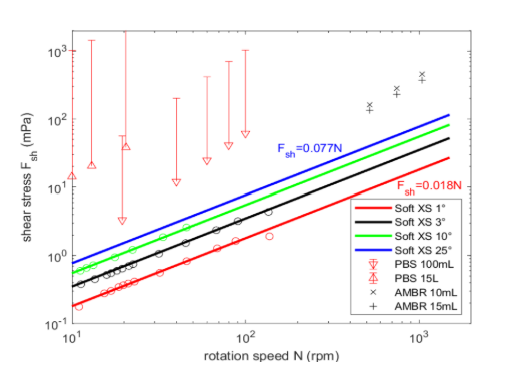
Figure 1. Contrainte de cisaillement hydrodynamique en fonction de la vitesse de rotation. La comparaison entre SoftXS™ et les technologies conventionnelles de culture en suspension démontre qu’une suspension homogène complète peut être obtenue tout en maintenant une contrainte de cisaillement inférieure à 20 mPa sur toute la plage de fonctionnement validée de SoftXS™.
La comparaison directe avec les technologies conventionnelles de culture en suspension a révélé des environnements de cisaillement nettement plus élevés, mettant en évidence la capacité de SoftXS™ à combiner une suspension homogène avec une contrainte mécanique exceptionnellement faible.
Conclusion
Cette étude démontre que la plateforme SoftXS™ permet une suspension robuste, reproductible et à faible cisaillement pour des volumes de travail allant de 10 mL à 250 mL, sans utilisation de turbines internes.
Trois principaux enseignements se dégagent de ce travail :
- Une suspension homogène reproductible à toutes les échelles étudiées
- Un comportement hydrodynamique prévisible gouverné par la taille des particules et les conditions de fonctionnement
- Un mélange efficace à faible cisaillement obtenu par rotation inclinée sans turbines
L’imagerie quantitative par feuille laser, les expériences de suivi des particules et la modélisation hydrodynamique confirment collectivement qu’une suspension complète, un mélange dynamique continu et une contrainte de cisaillement ultra-faible (<20 mPa) peuvent coexister au sein d’une même plateforme de bioréacteur évolutive.
Ces résultats établissent SoftXS™ comme une technologie de bioréacteur évolutive et contrôlable à faible cisaillement pour les applications nécessitant la mise en suspension douce de matériaux biologiques sensibles.