The Rise of Cell-Free Therapies
For decades, regenerative medicine has focused on transplanting living cells to repair damaged tissues and restore biological function. Stem cell therapies have shown remarkable promise across a wide range of applications, from neurological disorders to cardiovascular diseases and tissue regeneration.
However, despite encouraging results, cell-based therapies still face important challenges. Cell survival after transplantation, immune compatibility, manufacturing complexity, storage, and regulatory requirements all remain significant barriers to broader clinical adoption.
Increasingly, researchers have discovered that many of the therapeutic effects initially attributed to transplanted cells actually result from the bioactive molecules they release into their surrounding environment rather than from direct cell replacement.
This discovery has led to growing interest in an entirely new therapeutic approach: the cell secretome.
What Is the Cell Secretome?
The secretome refers to the complete collection of biologically active molecules secreted by cells during culture.
Rather than acting as passive by-products, these molecules serve as essential mediators of cellular communication and tissue homeostasis.
A typical secretome contains a highly complex mixture of:
- Growth factors
- Cytokines
- Chemokines
- Enzymes
- Extracellular vesicles
- Exosomes carrying proteins, lipids and RNA molecules
Together, these components continuously coordinate communication between cells, regulate inflammation, promote tissue repair, and influence many biological processes involved in healing and regeneration.
Why Scientists Are Looking Beyond Cell Therapy
The concept of using the secretome instead of living cells represents a major shift in regenerative medicine.
Instead of transplanting cells into patients, researchers aim to deliver only the therapeutic molecules naturally produced by those cells.
This cell-free strategy offers several potential advantages:
- Reduced immunological concerns
- Lower manufacturing complexity
- Easier storage and transportation
- Improved safety profile
- Simplified quality control
- Greater potential for large-scale manufacturing
Because secretome-based therapies contain no living cells, they may also offer a more standardized and scalable pathway toward clinical translation while preserving many of the regenerative benefits associated with stem cell therapies.
The Secretome Depends on How Cells Are Cultured
One of the most important findings emerging from recent research is that the secretome is not a fixed product.
Its composition changes continuously depending on the environment in which cells are cultured.
Factors such as oxygen concentration, nutrient availability, biochemical stimulation, and culture architecture all influence which therapeutic molecules cells release and in what quantities.
In other words, the manufacturing process directly shapes the biological properties of the final secretome product.
Why 3D Cell Culture Is Gaining Attention
Traditional secretome production has largely relied on conventional two-dimensional (2D) monolayer cultures.
While these systems are simple and well established, they poorly reproduce the natural microenvironment experienced by cells inside living tissues.
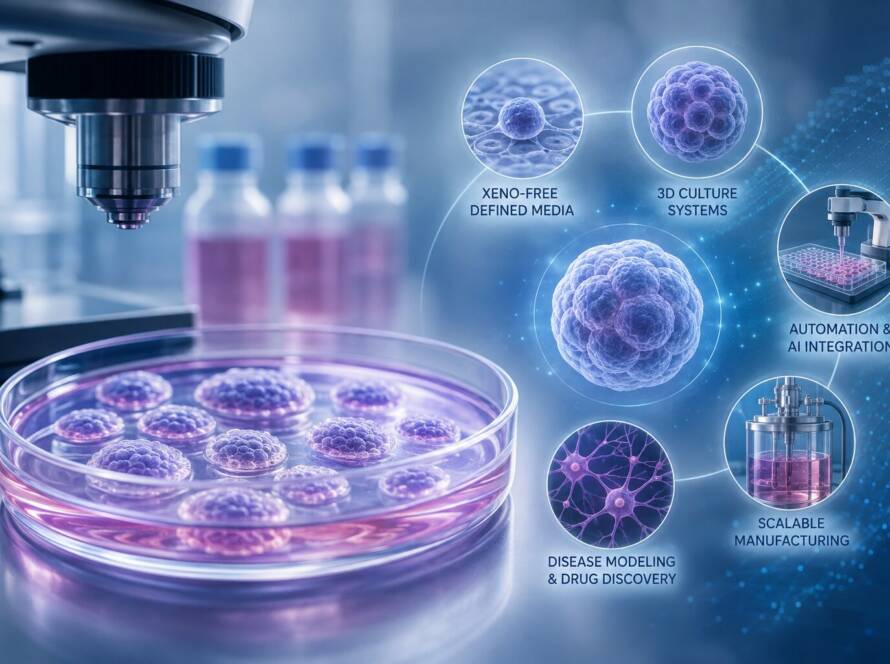
Three-dimensional (3D) culture systems are increasingly recognized as a more physiologically relevant alternative.
By allowing cells to establish more natural cell-cell interactions and experience realistic mechanical and biochemical cues, 3D cultures can significantly influence both the quantity and biological activity of secreted molecules.
Various approaches, including spheroids, extracellular matrix-based scaffolds and hydrogel systems have demonstrated improvements in regenerative properties, angiogenic signaling and wound healing potential compared with conventional 2D cultures.
Fine-Tuning the Cellular Microenvironment
Beyond culture architecture, researchers are actively exploring ways to optimize secretome production by carefully controlling the cellular microenvironment.
Several parameters have proven particularly influential:
Oxygen levels
Physiological oxygen concentrations are often much lower than those used in conventional laboratory culture.
Culturing cells under controlled hypoxic conditions has been shown to enhance regenerative signaling by activating hypoxia-responsive pathways and increasing the production of pro-angiogenic factors involved in tissue repair.
Biochemical stimulation
Exposure to selected cytokines, inflammatory mediators or growth factors can reshape the secretome by promoting the secretion of molecules involved in immune regulation, angiogenesis and tissue regeneration.
These strategies allow researchers to tailor secretome composition for specific therapeutic applications.
Standardization: The Key Challenge for Clinical Translation
Although secretome-based therapies hold enormous promise, one major obstacle remains before widespread clinical adoption becomes possible.
Today, there is still no universally standardized method for producing, collecting, processing or characterizing secretomes.
Differences in:
- Cell source
- Culture conditions
- Harvesting protocols
- Processing methods
- Storage conditions
- Analytical techniques
can all lead to significant variations in the composition and therapeutic activity of the final product.
Establishing reproducible manufacturing workflows will therefore be essential for ensuring consistent quality, safety and clinical efficacy.
From Laboratory Research to Industrial Manufacturing
Moving secretome therapies from academic laboratories to industrial production requires much more than biological discovery.
Every stage of the manufacturing workflow must be carefully optimized, including:
- Secretome production
- Collection under serum-free conditions
- Concentration and purification
- Storage while preserving bioactivity
- Molecular characterization
- Batch-to-batch quality control
At the same time, increasingly sophisticated analytical technologies, including mass spectrometry, RNA sequencing, transcriptomics and multi-omics approaches are helping researchers better understand secretome composition and identify biomarkers associated with therapeutic performance.
The Future of Secretome-Based Medicine
The next generation of secretome therapies will likely combine advances across multiple scientific disciplines.
Emerging technologies such as spatial omics, systems biology, artificial intelligence and advanced drug delivery platforms are expected to accelerate biomarker discovery, improve therapeutic precision and support the development of personalized regenerative treatments.
As manufacturing technologies continue to mature, secretome-based therapeutics have the potential to become an important new class of cell-free biologics for regenerative medicine.
Optimizing the Cell Culture Environment
As the field advances, it is becoming increasingly clear that producing a high-quality secretome begins long before downstream purification and characterization.
The physical and biological environment experienced by cells during culture plays a fundamental role in determining both the composition and therapeutic potential of the molecules they secrete.
Providing controlled, reproducible and physiologically relevant culture conditions is therefore emerging as an essential component of future secretome manufacturing strategies. Technologies designed to create gentle and well-controlled cellular environments may help support more consistent production processes while contributing to improved reproducibility and scalability for next-generation cell-derived therapeutics.
Looking Ahead
The growing interest in the secretome reflects a broader transformation in regenerative medicine from therapies based on living cells toward therapies based on the powerful biological signals they naturally produce.
As researchers continue to improve production methods, establish standardized manufacturing workflows and deepen their understanding of cell-derived signaling, secretome-based therapeutics are poised to become one of the most exciting areas of innovation in modern biotechnology.